
heart disease

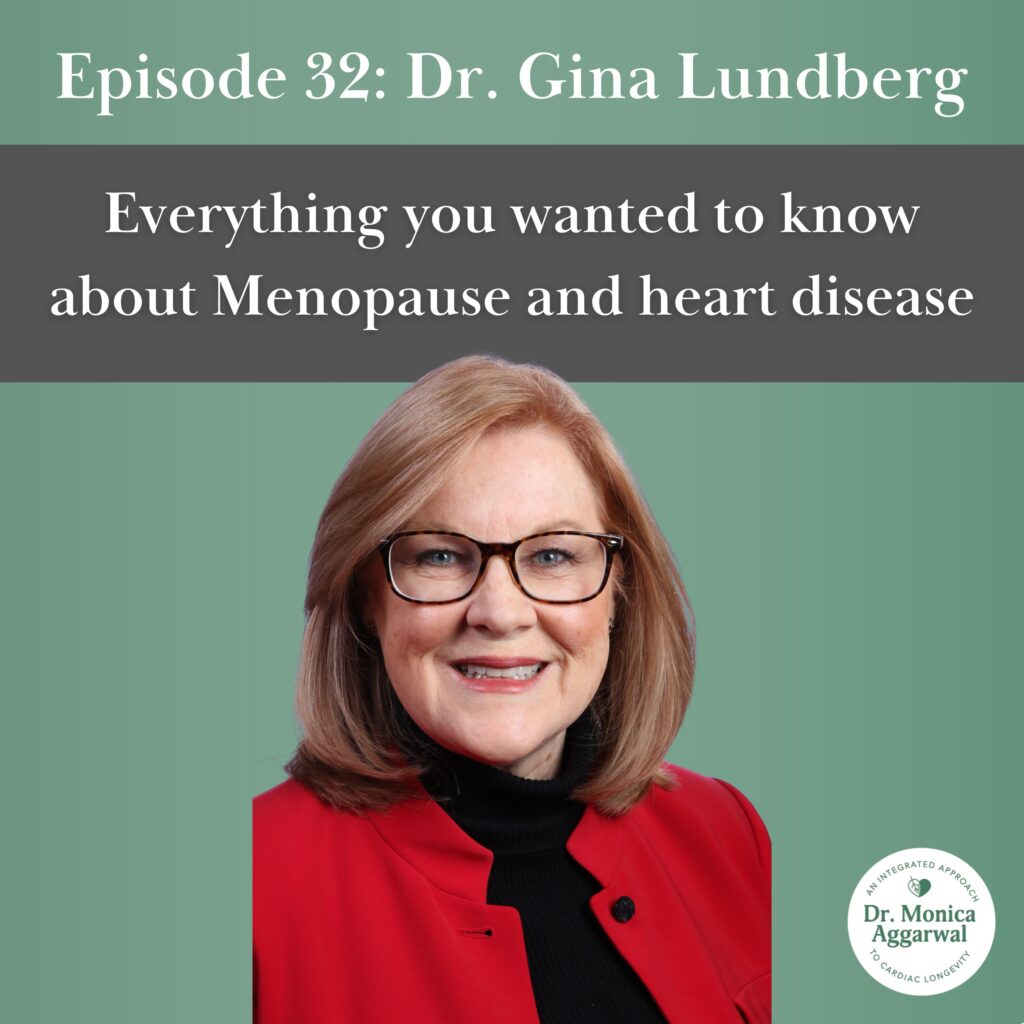
Everything You Wanted to Know About Menopause & Heart Disease with Dr. Gina Lundberg

In this episode, Dr. Monica Agarwal sits down with Dr. Gina Lundberg, a leading cardiologist and expert in women’s heart health, to demystify the complex relationship between menopause and cardiovascular disease. They tackle a range of critical topics, from understanding the subtle symptoms of heart attacks in women to the latest research on hormone replacement therapy and its timing. Dr. Lundberg sheds light on how to navigate this crucial life stage with your heart in mind, providing essential information on the safest and most effective treatment options.

Key Areas We Discuss

  • Cardiovascular disease awareness in women

  • The dismissal of women’s symptoms by medical professionals

  • The impact of menopause on heart health

  • Different types of hormone replacement therapy

  • Understanding the “timing hypothesis” for hormone therapy

  • Recommendations for safe hormone delivery methods

  • The relationship between menopause and bone density

  • The role of transdermal patches and oral hormones

  • Menopause as a cardiovascular disease risk factor

  • The importance of women in cardiology

  • The link between menopause and sexual health

About Gina Lundberg MD:

Gina Price Lundberg MD FACC is a preventive cardiologist with the Emory Clinic in East Cobb and at the Emory Saint Joseph Women’s Center. Dr. Lundberg is a Professor of Medicine at Emory University and Clinical Director of the Emory Womens Cardiovascular Health Center. She serves as the ACC Women in Cardiology (WIC) Leadership Council Chair and on the AHA Clinical Cardiology Leadership Council.

She is a National AHA Spokesperson. Dr. Lundberg has been a Board Member of the American Heart Association for Atlanta from 2001 until 2007 and was on the Southeast Affiliate Board 2006-2007. She also served on the SEA Strategic Health Initiatives Committee to promote Go Red for Women. She has been involved in every program related to the Go Red for Women initiative for the metro Atlanta area since its development in 2003.

She has been interviewed on the subject of Heart Disease in Women on CNN and in USA Today. Governor Sonny Perdue appointed Dr. Lundberg to the Advisory Board for the Department of Womens Health for the State of Georgia in 2007 until 2011. In 2005, Atlanta Woman Magazine awarded Dr. Lundberg the Top 10 Innovator Award for Medicine. In 2008, Atlanta Woman Magazine named her one of the Top 25 Professional Women to Watch and the only woman in the field of medicine. She was chosen a Top 10 Female Cardiologist on Social Media and is a Castle-Connally Top Doctor from 2016 to 2023. She was awarded the Castle-Connally Exceptional Women Doctor from 2017 to 2022.She has published over 65 articles in peer reviewed medical journals and contributed to several textbooks.

She attended the Medical College of Georgia and trained in Internal Medicine at Atlanta Medical Center (Georgia Baptist). Her cardiology fellowship was at Rush University in Chicago. She has been in practice in Atlanta since 1994. She is Board Certified in Cardiology and Internal Medicine and recertified in both in 2002. Dr. Lundberg has two children and considers motherhood her first and foremost career. Dr. Lundberg has lived most of her life in the metro Atlanta area. She enjoys spending time in the north Georgia mountains, snow skiing, travel and reading. She also enjoys serving as a short-term medical missionary and is involved in her church.

Everything You Wanted to Know About Menopause & Heart Disease with Dr. Gina Lundberg Read More »
Do you need stents if we see clogs in the heart?

Do we need stents if we see clogs in our hearts? Not always. In the setting of the ACUTE HEART attack, you will need an urgent treatment which requires a stent often. But in those people with stable symptoms, non-emergent, you don’t necessarily need a stent. It depends.

First, many plaques can be treated with aggressive medical and lifestyle therapy. We only consider stents when you have failed optimal medical therapy in a person with stable symptoms. Many people can be managed with medications and don’t need stents. Remember, stents do not make you live longer; they only make you feel better. If you have no symptoms, then why do you need a stent? If you have symptoms, such as chest pain or angina, lifestyle changes and medication are FIRST LINE. Stents should only be considered when people have symptoms despite optimal medical therapy and lifestyle changes or the symptoms become unstable. Just because you have a clog, doesn’t mean you need a stent.

Do you need stents if we see clogs in the heart? Read More »

What is a Plaque?

Do you know what the word heart plaque means? The job of blood vessels is to expand and constrict, depending on whether you need more or less blood to your organs.
If you have risk factors, your soft blood vessels can get damaged. Your body creates a band aid over the damaged area. Then cholesterol connects to the band aid and plaque is formed. This is the start of heart disease.

What is a Plaque? Read More »

What is a Coronary Artery?

Have you ever heard of coronary arteries? When we are talking about coronary arteries, we are thinking about heart attacks, clogs or stents in the heart. The coronary arteries sit on the heart and provides blood flow to the heart. If you don’t get good blood flow, then the heart can die in the area causing a heart attack.

What is a Coronary Artery? Read More »

What are Heart Palpitations?

Do you get flutters in your chest that you worry about? Palpitations are extra heart beats that people feel occasionally. Many people have them when they drink alcohol or caffeine. They can also be associated with stress, dehydration and illness. If you have frequent symptoms, you should see your physician.

What are Heart Palpitations? Read More »

What is Heart Disease?

Does the term heart disease confuse you? Heart disease is an umbrella term for many heart conditions. But classically, heart disease refers to when arteries in the heart get clogged.

Heart Disease Solutions Workshop

Combining lifestyle and medical solutions through a holistic approach you’ll gain the tools you need in the fight against heart disease.

What is Heart Disease? Read More »

Women Vs Inflammation Online Event

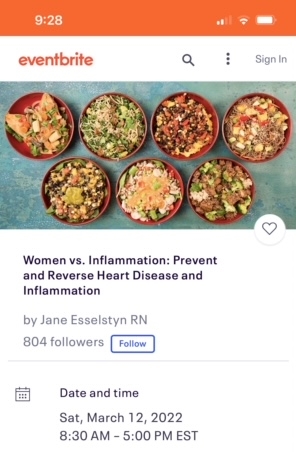
Have you all heard about Jane Esselstyn’s annual event? This year the focus is: Women vs. Inflammation: Prevent and Reverse Heart Disease and Inflammation. Jane does a great event each March and I have been privileged to be part of several of them. This was will be a virtual event. I will be speaking about inflammation and heart disease, one of my favorite topics. The best part of the event is the love, joy and fun that you will feel after this day. It really is fabulous and you will finish the day feeling full. I always feel great when I spend the day with them. Click here to register.

Women Vs Inflammation Online Event Read More »

I can eat McDonald’s today. I am still young.

Heart disease is the number one killer of men and women. In fact, heart disease will kill more women than men. While we are getting better at decreasing heart disease deaths with improved medical care, prevention is the key to the improvements.

People often believe that they can eat whatever they want when they are young because heart disease is not something they have to worry about. NOT TRUE. Heart disease is not a disease of the elderly. It is a spectrum disease that starts in the young. If you look at Korean and Vietnam war soldiers autopsies, there were notable fatty streaks and cholesterol plaque in their heart arteries.

A study was done in JAMA in 1999 that looked at 2876 autopsies of men and women, ages 15-34, who died of external causes. Plaque was noted in ALL of the aortas (pipe that exists the heart and gives the body blood). More than 1/2 of the right coronary arteries (arteries that give blood to the heart so it can pump) in the 15-19 year old age group had plaque and more as the group aged. Fatty streaks were more notable in the black patients, than the white patients.

This is a compelling picture that shows the plaque in the heart arteries. The darker the colors, the more the plaque. Notice the plaque in the youngest group.

What you eat matters. What you feed your children matters. If you think you can feed your children McDonald’s or eat it yourself, think again. You likely already have plaque in your heart arteries. What can you do to change this? Change your diet, decrease the triggers for plaque and prevent inflammation. A moment on the lips, truly is a lifetime in the body.

I can eat McDonald’s today. I am still young. Read More »

Without meat and eggs, no protein?

People ask me all the time about how I get my protein without eggs, meat and cheese. I just had this question today in clinic. In America, we are fixated with our protein sources. There is plenty of protein in beans and lentils that I promise you. You do not need animal products to get energy. You will actually find that without the animal products, you will likely feel lighter. I find that it is sugars and processed foods that make most people low in energy. It creates the ups and downs in sugar levels that lead that to that post lunch drowsiness. I dont get that!

Meat and eggs have been shown to go into the gut where the gut produces TMAO. This is a substance that has been shown to increase plaque in the heart arteries and increase bad heart outcomes. http://www.nejm.org/doi/full/10.1056/NEJMoa1109400

Some of the best athletes in the world don’t eat meat, dairy or eggs. I am the strongest I have ever been without these things!

Without meat and eggs, no protein? Read More »

Shopping Cart
Scroll to Top